
Sometimes the next breakthrough that improves our lives is not a new invention at all. It is something that has been here all along — a technology quietly shaping the world for decades — waiting for someone to figure out how to put it to work where it is needed most.
There is an instrument, first built 80 years ago in the middle of a world war, that can identify a single type of reactive molecule hiding inside food, blood, batteries, or medicine — molecules so small and so short-lived that most other methods never register them at all. It is called Electron Paramagnetic Resonance, or EPR. Its story is a genuinely interesting one, and it says a lot about where science, and food safety, are headed next.
How Electron Paramagnetic Resonance (EPR) Was Born
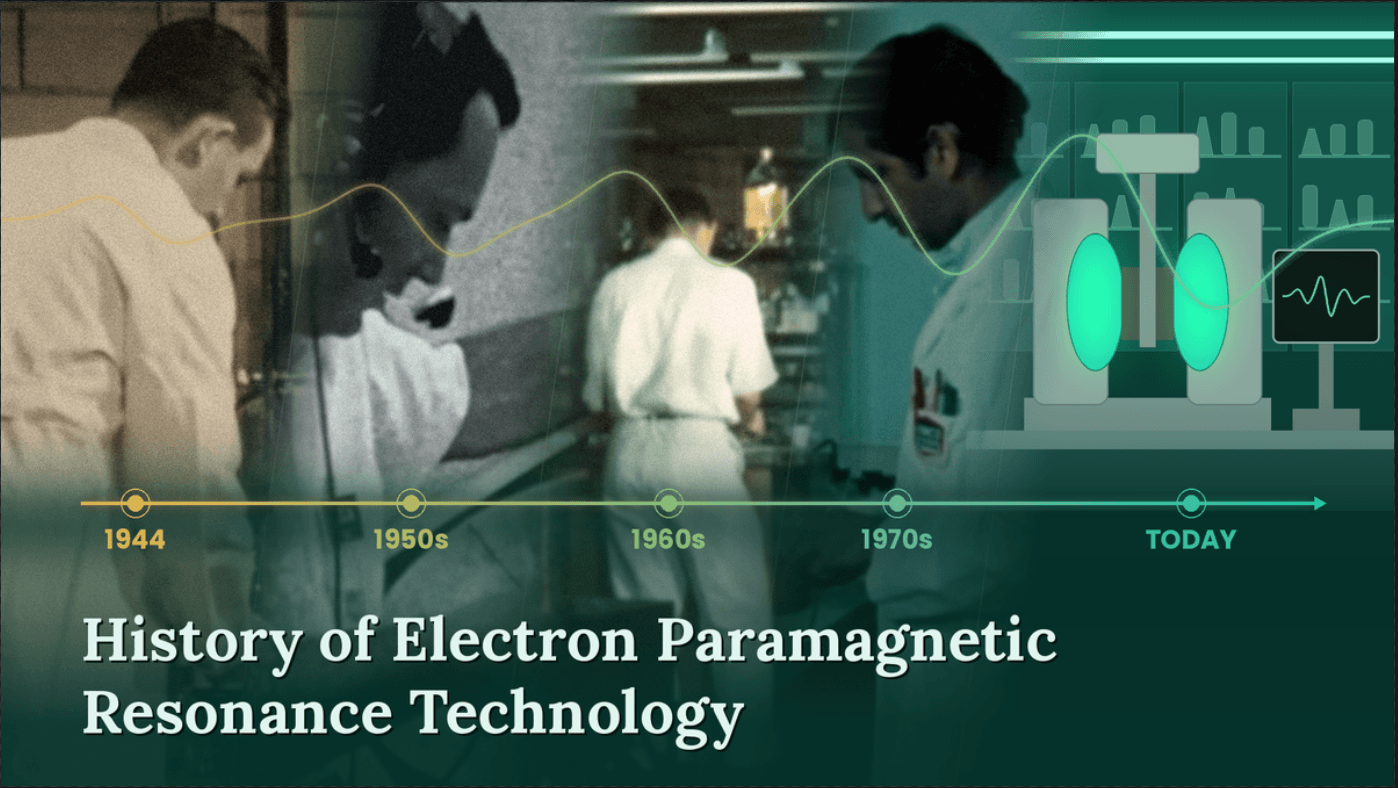
In 1944, a physicist named Yevgeny Zavoisky was working at Kazan State University in the Soviet Union during the war. Using a spectrometer he'd built himself, he recorded something nobody had measured before: a clean, repeatable signal from electrons absorbing energy under very specific conditions. He checked it with copper and manganese salts, and it held up.
The research explains the key insight that made it work. His key move was adding a small oscillating magnetic field, which boosted the signal enough to read straight off an oscilloscope instead of relying on the detection methods of the time. That fix opened up a whole new branch of science, and he was later nominated for the Nobel Prize several times, in both physics and chemistry, according to the record kept by his home institution.
How EPR Works
The basic idea is less intimidating than the name.
Every electron spins, and that spin makes it behave like a minuscule magnet. Most electrons travel in balanced pairs that cancel each other out, so they leave no trace. But some molecules carry a single, unpaired electron — and that lone electron acts like a tiny bar magnet all on its own.
If you put that molecule in a strong magnetic field and hit it with microwaves at exactly the right frequency, the electron flips and absorbs a measurable bit of energy as it does. Different molecules flip under slightly different conditions, so the signal also tells you what you're looking at.
It belongs to the same family of physics as the MRI machine in a hospital. An MRI reads the nuclei at the center of atoms; EPR reads the electrons instead. Because electrons are far stronger magnets, EPR is remarkably sensitive — by some measures up to a thousand times more sensitive than its better-known relative, NMR, according to data compiled by university chemistry references.
The Scientists of EPR
Zavoisky wasn't the only one working on this. Around the same time, British physicist Brebis Bleaney developed the same technique independently at Oxford. Zavoisky showed it could be done, and Bleaney and his colleagues at the Clarendon Laboratory spent the years after the war turning it into a precise instrument, mostly studying transition-metal ions in crystals. The textbook he co-wrote is still a standard reference, and in 1992 he received the award named after Zavoisky.
That work is still going. Dr. Nathan Newman's group at Arizona State, for example, has used low-frequency EPR to resolve fine structural details in advanced materials that older approaches couldn't make out clearly, the kind of exacting research that keeps pushing the technique's sensitivity and precision forward. Eight decades in, people are still finding ways to make it sharper.
Where You'll Find EPR Today
Eighty years on, EPR quietly does the unglamorous, important work behind a lot of modern life. Here are some examples of what happens behind the scenes:
- In medicine and drug development, it detects free radicals linked to cancer, Alzheimer's, and heart disease, and helps check whether a new drug stays stable or starts breaking down into something toxic. It's one of very few tools that can detect these radicals directly according to the research.
- In food safety, it can flag spoilage, test whether antioxidants are actually doing anything, and confirm whether a food was sterilized with radiation. The data shows it is one of the most accurate ways to prove a product was irradiated.
- In batteries, it finds the small defects that decide whether a phone battery lasts two years or fails badly per research on lithium-ion cells.
- After radiation accidents, it can estimate how much dose a person absorbed by measuring a tooth or a fingernail, a technique the research calls EPR dosimetry.
Given all that, you'd expect to find EPR in every lab. You won't. For most of its history it's been a large, power-hungry machine built around a serious magnet, usually needing its own room. Ordinary businesses don't buy one and plug it in. They sit in universities, research institutes, and national labs. The U.S. Department of Energy, for instance, runs EPR as a shared national facility that outside scientists must formally apply to use, per its own documentation — which tells you just how specialized this equipment has been.
What's Next
So for about 80 years, EPR has been an incredibly capable tool that only a small number of facilities could actually use.
I think that's starting to change. Everyone is pushing for better batteries, safer drugs, cleaner food, and new materials, and more of those people need what EPR uniquely does: detect reactive, unpaired-electron species that almost nothing else can see. Interest is growing faster than it has at any point since Zavoisky saw that first signal in Kazan.
Sources
- Kazan Federal University — "Yevgeny Zavoisky discovers electron paramagnetic resonance." eng.kpfu.ru
- Yevgeny Zavoisky — biography and detection method. Wikipedia. wikipedia.org
- Kazan National Research Technical University (KAI) — Zavoisky profile and Nobel nominations. kai.ru
- Brebis Bleaney — independent development of EPR at Oxford; Zavoisky Award (1992). Wikipedia. wikipedia.org
- Brebis Bleaney obituary, Physics Today (2007) — postwar development of EPR at the Clarendon Laboratory. physicstoday.aip.org
- Zhang, Gonzalez, Antholine & Newman (2018), "Better Resolution of High-Spin Cobalt Hyperfine at Low Frequency," Int. J. Mol. Sci. pmc.ncbi.nlm.nih.gov
- Suzen, Gurer-Orhan & Saso (2017), "Detection of Reactive Oxygen and Nitrogen Species by EPR," Molecules. pmc.ncbi.nlm.nih.gov
- EPR spectroscopy in food analysis — detection of irradiated foods and antioxidant capacity (repository, Cyprus Univ. of Technology). ktisis.cut.ac.cy
- SciMed — "Analysing lithium-ion batteries using EPR spectroscopy." scimed.co.uk
- EPR tooth-enamel dosimetry — radiation dose reconstruction. academia.edu
- U.S. DOE Environmental Molecular Sciences Laboratory — EPR national user facility. emsl.pnnl.gov
- LibreTexts (Physical & Theoretical Chemistry) — "EPR: Theory" (EPR sensitivity relative to NMR). chem.libretexts.org